
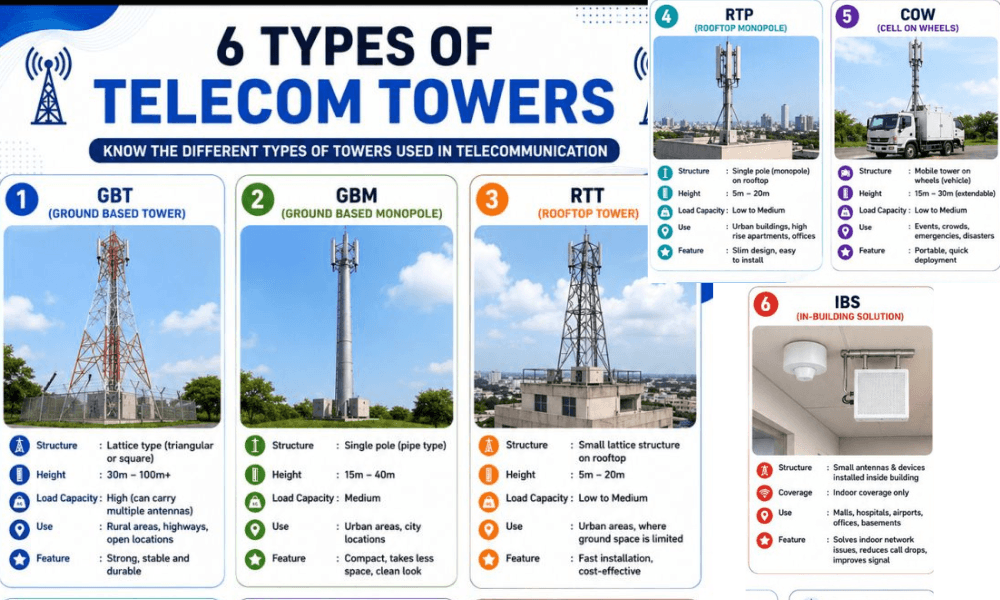
Different environments require different infrastructure solutions to ensure reliable mobile coverage, network capacity, and seamless connectivity. From regional highways to dense urban buildings, each type of telecom structure plays a specific role in keeping communities connected.
Here are some common types of telecommunications infrastructure used across modern networks: 🔹 Ground Based Towers (GBT)Large lattice towers commonly used in rural and open areas. These structures support multiple antennas and provide wide-area coverage with high load capacity.
🔹 Ground Based Monopoles (GBM)
Single-pole towers designed for urban environments where space is limited. Compact, clean in appearance, and ideal for city deployments.
🔹 Rooftop Towers (RTT)
Installed on building rooftops to improve coverage and capacity in densely populated urban locations.
🔹 Rooftop Monopoles (RTP)
Slim monopole structures mounted on rooftops, commonly used in high-rise and metropolitan environments.
🔹 Cell on Wheels (COW)
Portable mobile tower systems deployed during events, emergencies, disasters, or temporary capacity requirements.
🔹 In-Building Solutions (IBS)
Indoor coverage systems installed inside malls, hospitals, airports, offices, and other large facilities to improve indoor signal strength and reduce call drops.
Each solution is engineered based on: • Coverage requirements • Capacity demands • Environmental conditions • Site accessibility • Urban or regional deployment needs
Telecommunications infrastructure is far more than just towers, it’s a carefully designed ecosystem that enables reliable communication across cities, regional communities, transport corridors, and critical facilities. Proud to be part of an industry that builds and maintains the infrastructure connecting millions every day.